
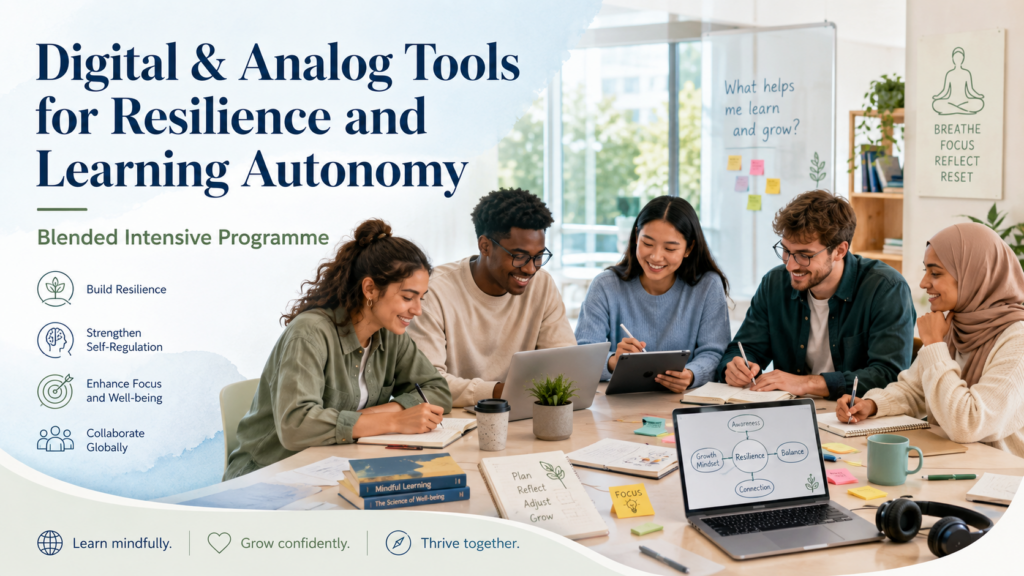
Self-Leadership in Academia: AI, Mindfulness, Meditation, Yoga, and Self-Regulated Learning
This Blended Intensive Programme supports students in developing practical strategies for academic resilience, stress regulation, focused learning, and sustainable recovery. The programme combines online learning with an in-person week in Erlangen and offers an applied, reflective, and community-based learning experience.
Online phase
1 January 2027 – 1 February 2027
On-site phase
22 February – 26 February 2027
Daily on-site schedule
Monday to Friday, 9:00 a.m. – 1:00 p.m.
Location
Kochstraße, Erlangen, Germany
BIP Name: Digital & Analog Tools for Resilience and Learning Autonomy
BIP Nummer: 2025-1-DE01-KA131-HED-000307460-1
Application & Registration
Please register via: jana.metz@fau.de
Application deadline: 15 September 2026
Erasmus+ eligible partner institutions: Istanbul Technical University (ITU), Budapest University of Technology and Economics (BME), and Paris Sciences et Lettres – PSL University.
Please also register separately for the city tour and the working dinner.
What this programme offers
Participants explore how stress, recovery, self-regulated learning, AI-supported study practices, mindfulness, meditation, and body-based approaches interact in academic life. The programme is designed for students who want to strengthen their self-leadership and develop realistic tools they can apply in study, work, and everyday routines.
The online phase introduces key concepts and reflection tasks. During the in-person week, participants engage in workshops, guided exercises, exchange with peers, and practical sessions that connect theory and lived experience.
Organisers
Dr Isabelle May
Friedrich-Alexander-Universität Erlangen-Nürnberg
Angelika Zindel
Friedrich-Alexander-Universität Erlangen-Nürnberg
Registration contact
jana.metz@fau.de
Programme focus
Self-leadership Academic resilience AI in academia Mindfulness Meditation Yoga Stress management Self-regulated learning
The programme addresses the demands of academic life from both psychological and practical perspectives. Participants learn how to identify stressors and early warning signs, understand patterns of attention and recovery, reflect on the role of AI in academic work, strengthen goal-directed learning, and build routines that support well-being and academic functioning.
The programme also includes a city tour and a working dinner. Registration is required for both activities. No prior experience in yoga, mindfulness, or meditation is required; all practical sessions are designed at beginner level.
Learning objectives
- Understand central concepts of stress, self-regulation, and recovery in academic settings.
- Develop realistic strategies for planning, monitoring, and adapting one’s own learning.
- Experience mindfulness, meditation, and yoga as complementary tools for self-leadership.
- Reflect critically and practically on the role of AI and digital tools in academic work and stress regulation.
- Create an individual action plan for sustainable study routines and recovery practices.
Blended format
Online phase (1 January 2027 – 1 February 2027)
Participants complete guided online modules, short reflection tasks, and preparatory activities. The online phase establishes a shared conceptual basis and prepares participants for the practical and interactive elements of the in-person week.
In-person phase (22–26 February 2027)
The on-site phase in Erlangen focuses on application, discussion, embodied practice, and collaborative reflection. Sessions take place from Monday to Friday, daily from 9:00 a.m. to 1:00 p.m.
On-site programme in Erlangen
Monday, 22 February 2027 – Arrival, orientation, and opening session
The first day is intended for arrival, orientation, and a shared start into the programme. Participants get to know each other, receive an overview of the week, and are introduced to the main themes of the programme. The session creates a common foundation for the following days and allows participants to arrive both organisationally and mentally.
- Opening reflection on expectations and goals
- Arrival and welcome
- Orientation and introduction to the programme
- Getting to know each other
- Overview of the week and main topics
Tuesday, 23 February 2027 – Welcome, orientation, and academic self-leadership
The second day introduces participants to the programme, the learning community, and the central concept of self-leadership in academia. Participants reflect on their current academic challenges, personal resources, and expectations for the week. The day also opens the discussion on how digital tools and AI shape academic work, productivity, and stress.
- Welcome and programme introduction
- Getting to know each other and expectation mapping
- Introduction to self-leadership, stress, and academic resilience
- First exchange on AI and digital tools in academic life
Wednesday, 24 February 2027 – Beginner yoga, mindfulness, and awareness
The third day begins with a gentle yoga session at beginner level. Participants then explore mindfulness and meditation as practical tools for awareness, emotional balance, and focused attention. The aim is to identify realistic ways to integrate brief practices into academic routines.
- Morning yoga session for beginners
- Introduction to mindfulness and meditation in academic life
- Reflection on stress signals, attention, and emotional regulation
- Transfer to everyday study and work routines
Thursday, 25 February 2027 – Beginner yoga, AI, and self-regulated learning
After a second beginner-friendly yoga session, participants focus on self-regulated learning and on the question of how AI can support or complicate academic work. The day encourages a reflective and responsible use of digital tools while strengthening planning, monitoring, and adaptive learning strategies.
- Morning yoga session for beginners
- Workshop on self-regulated learning strategies
- Reflecting on opportunities and risks of AI in academia
- Developing realistic strategies for focused and responsible tool use
Friday, 26 February 2027 – Beginner yoga, recovery, integration, and next steps
The final day starts once more with yoga and then brings together the week’s key themes: stress, AI, recovery, mindfulness, meditation, and self-regulated learning. Participants consolidate their insights, create an individual action plan, and identify practical next steps for their academic lives.
- Morning yoga session for beginners
- Reflection on recovery, breaks, and sustainable study routines
- Creating an individual self-leadership action plan
- Closing reflection and farewell
Additional programme elements
- City tour in Erlangen: included in the programme; separate registration required.
- Working dinner: included in the programme; separate registration required.
- Practical sessions: no previous experience is required; yoga, mindfulness, and meditation activities are designed for beginners.
Registration and practical information
- Erasmus+ eligible partner institutions: Istanbul Technical University (ITU), Budapest University of Technology and Economics (BME), and Paris Sciences et Lettres – PSL University.
- Application deadline: 1 August 2026.
- Detailed registration information will be shared via the participating universities and the FAU coordination process.
- Please register in time for the city tour and working dinner.
- Participants are responsible for arranging their travel and accommodation in Erlangen.
- Further practical information about arrival, access, and online participation will be provided after nomination and registration.
Venue
Friedrich-Alexander-Universität Erlangen-Nürnberg (FAU)
Kochstraße
Erlangen, Germany
The on-site phase takes place in Erlangen, a university city with a strong academic tradition and an accessible city centre. The programme combines structured learning with opportunities for exchange, reflection, and shared experience.